

BASED ON TRUE EVENTS.
85 CASES OF JUDICIAL, CLERICAL AND ACADEMIC MISUSE AND HUMAN FAILURE with
MONEY, INTIMACY AND PROCEDURE AT THE CORE.
From the author
8 May 2026:
“Since the publication of this volume on 25 February 2026, fifty copies were dispatched to the very institutions upon which its chapters are founded - courts, judicial institutions, universities, churches whose records, histories, or silences form the backbone of the narrative.
The response was immediate in one respect, and absolute in another.
Publicly: nothing.
No statements. No objections. No corrections. No denials.
Privately, however, the movement was unmistakable.
Website traffic surged beyond all previous baselines. Names searched. Identifiers analysed. Cases compared. The readership expanded precisely where the book was expected to be unwelcome.
This silence is neither indifference nor ignorance. It is institutional instinct.
For institutions built equally upon reputation and authority, direct engagement carries risk. To answer is to acknowledge. To refute is to legitimise scrutiny. And to remain silent, while quietly observing, is often the preferred defence of the modern robe and ledger alike. The prediction, therefore, proved accurate: silence itself became the response.
Page 8:
“Silence can be a deliberate instrument; so can formality. A signature, a stamp, a robe, a collar - each can steady standalone the public gaze while misdirection does its work. When the record is incomplete, the omission is part of the story: absence is often the loudest evidence.”
Page 14:

“If your first impulse is to dispute, discredit, or defend, I’d ask: why begin with a fight before you’ve even tested whether this could reduce foreseeable harm? A defensive posture may protect the institution’s image in the short term, but it also signals that the primary goal is containment rather than learning.
My claim is not that "institutions are evil." My claim is structural: institutions protect continuity and treat accountability as a reputational risk, so reform arrives reactively after exposure. If you believe that characterization is unfair, here is a concrete way to prove it wrong: [….]”

ROBES, JABOTS AND HUMAN FAILURE
“IN A WORLD OF ROBES AND JABOTS, TRUTH IS THE ONE THING NOBODY CAN AFFORD.”
FROM THE PUBLISHER | OUR MOTIVATION TO PUBLISH AND MARKET
“The Robe AND the Ledger”
Non-Fiction | Politics & Social Sciences | Institutional Critique & Policy Blueprint
The symbols of authority - robes, hoods, collars, titles, and rituals - are meant to inspire trust. They suggest dignity, order, and protection. But they can also hide the people and processes that cause harm.
Through a series of case studies set in courts, churches, laboratories, and universities, this book reveals a pattern repeated across respected institutions: money quietly redirected, decisions made off the record, complaints blocked by procedure, and harm allowed to grow long before it becomes public.
This is not simply a story of individual wrongdoing. It is a story about systems - about the ordinary routines through which accountability is weakened and concealment becomes normal.
Clear, humane, and highly readable, this book shows how institutions created to protect people can end up protecting themselves.
It also offers a practical response: the Personal Reason-Giving Record (PRGR), a reform designed to make systems identify the people behind their decisions and hold them accountable.
The PRGR (Personal Reason-Giving Record) - a simple, scalable accountability system built on one radical principle:
Every harm must have a named author.
PRGR is not a theory or a slogan. It’s a practical technology for responsibility - designed to make the invisible mechanics of power visible, traceable, and reformable.
In a world full of books that identify what’s broken, The Robe and the Ledger offers a concrete method for forcing institutions to own what they do.
Why this book stays with you
You don’t just read the pattern - you learn to see it. The book uses repetition as a deliberate rhetorical device, training your eye to recognize how harm repeats under different uniforms and vocabularies.
Genre-bending with purpose. Part investigative non-fiction, part institutional critique, part memoir, part practical user’s manual - its emotional core makes the analysis hit harder, and its policy blueprint makes the emotion useful.
Rigorous and unforgettably human. The systems are examined with clarity and discipline, but the stakes never become abstract: this is about real lives shaped by decisions nobody wants to “own.”
If you care about ethics, justice reform, institutional accountability - or you’ve ever wondered why the truth can be obvious and still go nowhere - The Robe and the Ledger will change how you recognize power.
And it will give you a way to challenge it.
689 PAGES, PAPERBACK 6’’ * 9”, EPub, KPD (amazon.com),
RECOMMENDED FOR ORDERING (HIGH QUALITY PRINT): BOOKS.BY/ROBES-LEDGERS
WHAT THE BOOK CRITICS SAY

“There’s a particular kind of book that doesn’t ask for your attention so much as it recalibrates it. The Robe and the Ledger is one of those rare works. It begins like an investigation and ends like an indictment - not of individuals, but of the quiet machinery that allows harm to persist in plain sight.
Alex Matthews structures the book around composite cases drawn from courts, churches, and universities -institutions that trade in trust, ritual, and authority. What emerges is not a parade of villains, but something far more unsettling: a pattern. Decisions made “by process,” accountability dissolved into committees, and harm diffused until no one quite owns it.
What struck me most is Matthews’ refusal to sensationalize. The prose is controlled, almost surgical, even when the subject matter is anything but. That restraint becomes the book’s moral force. These are not explosive scandals; they are slow failures -administrative, procedural, and deeply human. And that’s precisely why they linger.
The book’s most ambitious move is its insistence on structure over outrage. Matthews isn’t content to expose wrongdoing; he wants readers to see how harm repeats across systems that appear unrelated but operate with the same internal logic. The repetition is deliberate. By the third or fourth case, you’re no longer surprised - you’re trained. You begin to recognize the choreography of evasion.
Not every reader will embrace the book’s proposed solution - the Personal Reason-Giving Record (PRGR), a framework designed to force decision-makers to attach their names to consequential actions. It’s pragmatic, almost bureaucratic in its simplicity, and that’s both its strength and its vulnerability. Whether it can meaningfully disrupt entrenched systems is an open question. But its presence elevates the book from critique to provocation.
Stylistically, The Robe and the Ledger sits somewhere between legal nonfiction, institutional critique, and moral philosophy. It’s not always comfortable reading. Nor is it meant to be. Matthews is less interested in narrative closure than in cognitive friction - he wants you to notice what you’ve been trained to overlook.
This is not a book that flatters its reader. It implicates them.
By the final pages, what lingers isn’t outrage, but recognition - the unsettling sense that the systems we trust most are often designed to diffuse responsibility rather than enforce it. And once you see that, Matthews suggests, you can’t unsee it.
The Robe and the Ledger doesn’t just tell a story. It teaches you how to read power.
- and that may be its most dangerous idea.”
Harriet “Hattie” Quinn (Critic, NY)
”Quiet choices, explosive consequences. These composite cases read like investigations - except they’re painfully familiar.”
“Stille keuzes, explosieve gevolgen. Deze samengestelde casus lezen als onderzoeken - behalve dat ze pijnlijk herkenbaar zijn.”
Bernard Visser, Amsterdam


“They told us to trust the collar. We trusted and it broke people. This book collects the quiet tragedies hidden behind ceremony - raw, humane, urgent.”
„Sie sagten uns, wir sollten dem Kragen vertrauen. Wir haben vertraut - und er hat Menschen zerbrochen. Dieses Buch sammelt die stillen Tragödien, die sich hinter der Zeremonie verbergen - roh, menschlich, dringlich.“
Dr. Elena Vogt, Munich

“Da una prospettiva critica italiana, The Robe and the Ledger giunge in un momento particolarmente significativo. L’Italia, con la sua lunga e complessa relazione con la Chiesa, non è estranea a episodi storici di corruzione istituzionale - episodi che hanno plasmato la fiducia pubblica e continuano a influenzare il dibattito contemporaneo. In questo contesto, il libro appare non solo rilevante, ma necessario.
Ciò che distingue quest’opera è il suo rifiuto di considerare le derive etiche come episodi isolati o deviazioni recenti. Al contrario, presenta una narrazione approfondita che si estende per decenni, mettendo in luce schemi ricorrenti piuttosto che anomalie. L’autore sostiene in modo convincente che il problema centrale non sia soltanto la corruzione in senso tradizionale, ma un’assenza sistemica di un giudizio etico fondato sull’elemento umano nei processi decisionali. Non si tratta della storia di pochi individui, ma di strutture istituzionali che, nel tempo, si sono allontanate dalla responsabilità e dalla dimensione morale.
L’urgenza del libro risiede proprio in questa prospettiva di lungo periodo. Tracciando tali problematiche attraverso le generazioni, The Robe and the Ledger invita il lettore a riconsiderare le proprie convinzioni su riforma e progresso. Suggerisce che, senza affrontare i meccanismi strutturali che consentono tali vuoti etici, un cambiamento significativo rimane difficile da realizzare.
Per i lettori in Italia e altrove, il libro rappresenta sia una riflessione storica sia un monito contemporaneo. Si tratta di una critica sobria e metodica che sottolinea la perdurante rilevanza del suo tema, le cui implicazioni si estendono ben oltre le istituzioni specifiche analizzate.”
Giovanni Ferraro, Dottore in Giurisprudenza, Milano
“From an Italian critical perspective, The Robe and the Ledger arrives at a particularly resonant moment. Italy, with its long and complex relationship with the Church, is no stranger to historical episodes of institutional corruption -episodes that have shaped public trust and continue to inform contemporary discourse. Against this backdrop, the book feels not only relevant, but necessary.
What distinguishes this work is its refusal to frame ethical failures as isolated incidents or recent deviations. Instead, it presents a deeply researched narrative that spans decades, revealing patterns rather than anomalies. The author convincingly argues that the core issue is not merely corruption in the conventional sense, but a systemic absence of human-centered ethical judgment in decision-making processes. This is not a story of a few bad actors, but of institutional structures that, over time, have distanced themselves from accountability and moral responsibility.
The urgency of the book lies precisely in this longitudinal perspective. By tracing these issues across generations, The Robe and the Ledger challenges the reader to reconsider assumptions about reform and progress. It suggests that without addressing the underlying frameworks that permit such ethical voids, meaningful change remains elusive.
For readers in Italy and beyond, the book serves as both a historical reflection and a contemporary warning. It is a sober, methodical critique that underscores the enduring relevance of its subject matter, and its implications extend far beyond the specific institutions it examines.”



“The robes speak when no one’s watching - and the truth is worse than you think. Read The Robe and the Ledger - ROBES, JABOTS and HUMAN FAILURE for eye-opening; impossible-to-ignore stories about power and silence.”
“ Les robes parlent quand personne ne regarde - et la vérité est pire que vous ne l’imaginez. Lisez The Robe and the Ledger - ROBES, JABOTS and HUMAN FAILURE pour des récits saisissants, impossibles à ignorer, sur le pouvoir et le silence.”
Vivianne La Roche, Paris
“The Robe and the Ledger reads as a timely and quietly forceful examination of institutional conduct. Audiences in both the UK and Australia are well accustomed to public inquiries and investigations that have exposed failures within powerful organisations, particularly where moral responsibility has been overshadowed by administrative or financial priorities. This book contributes meaningfully to that ongoing dialogue.
Rather than concentrating on isolated controversies, the author adopts a broader historical lens, assembling a narrative that unfolds over an extended period. This approach shifts the focus away from individual incidents and toward enduring patterns of behaviour. The result is a study that suggests the problem lies not in occasional lapses, but in entrenched systems where ethical considerations are too often secondary.
A central thread throughout the work is the diminishing presence of genuine human judgment in decision-making. Policies, structures, and institutional interests appear to take precedence, creating an environment where accountability becomes diffuse and moral clarity is weakened. For readers familiar with developments in both Australia and the United Kingdom, this theme will feel particularly relevant.
What ultimately distinguishes The Robe and the Ledger is its measured tone and analytical consistency. It avoids exaggeration, instead building its case through accumulation and careful observation. In doing so, it highlights not only the persistence of these issues, but also their broader significance - suggesting that without deeper structural reflection, similar patterns are likely to continue.”
Brian McDonell, Birmingham - Sydney

“Behind composed robes are urgent scandals and urgent reforms - whistleblowers, investigations, consequences. This book reads like a legal thriller - except it’s real.”
“ Detrás de las togas impecables hay escándalos urgentes y reformas necesarias: denunciantes, investigaciones y consecuencias. Este libro se lee como un thriller legal, salvo que es real.”
Ignatio Valera, Barcelona
ORDER NOW
To save on shipping costs, we advice buyers outside Australia to order the book via www.books.by/robes-ledgers.
ALSO available AT:
KPD-AMAZON (available for free on kindle unlimited).
order the book via www.amazon.com
Delivery via Amazon: approx. 3 business days, but may vary due to your location. Shipment as a gift is possible.
SPECIAL OFFER FOR A SPECIFIC GROUP OF READERS
Get a paperback (valued at US$ 29.95) for free!
Are you a journalist, book review blogger (min 10k followers), researcher, book critic, publisher, book agent, an institution or its representative, an acting judge, an NGO representative?
Send an email to the author’s marketing team: author@robesjabots.com,
and our friendly team will send you a copy of the book for free.
WE ONLY ASK FOR A SINCERE REVIEW OR FEEDBACK.
We might ask you some details to ensure your identity and profession qualifies for this offer.The book will be marked with a banner “not for resale” on the cover. Limited edition.
The publisher
WORLDWIDE DISTRIBUTION THROUGH Ingramspark (only for retailers):

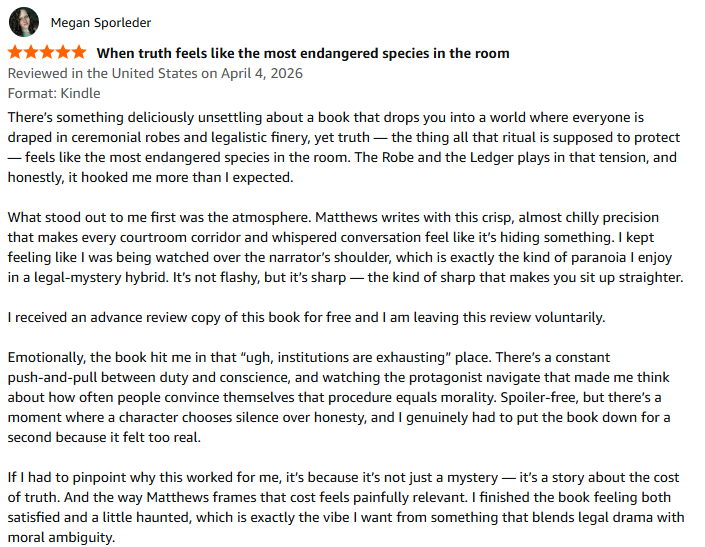
REVIEWS* BY READERS
click for on one review to read all
*Reviews statistics as per 27 May 2026
Source: amazon.com
Not included: amazon.nl and amazon.com.au

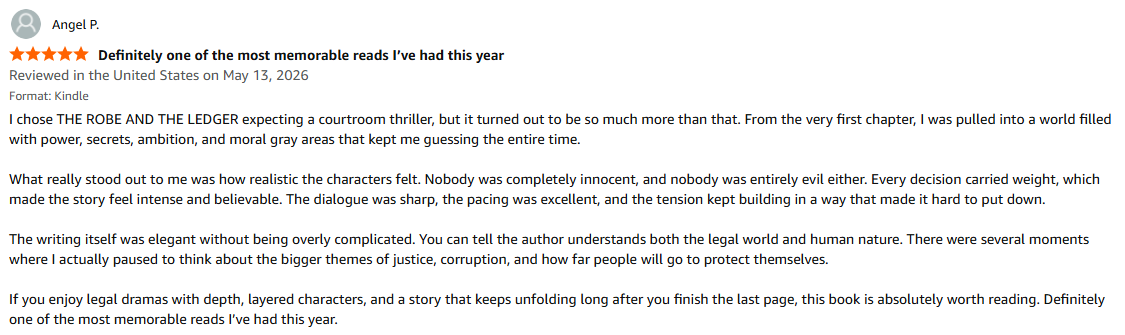
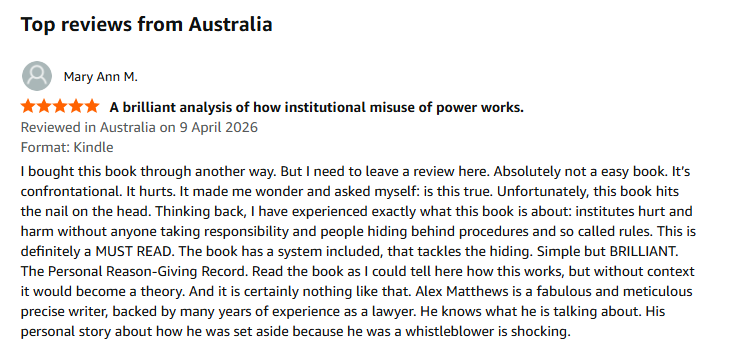
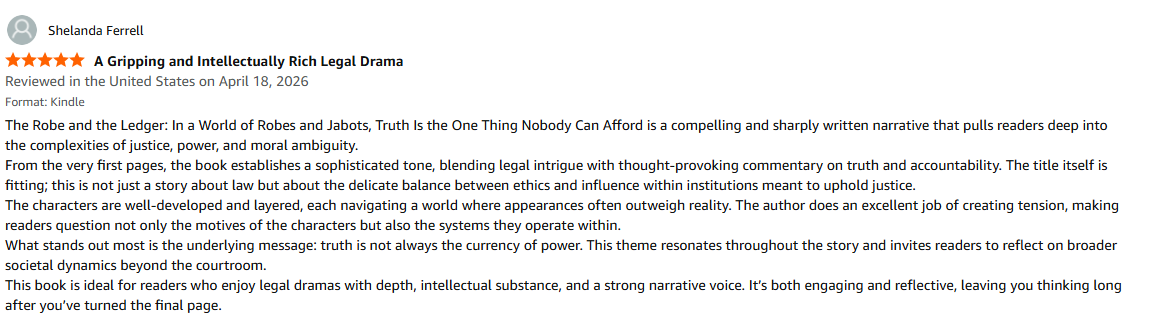
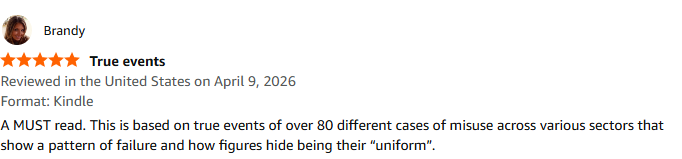
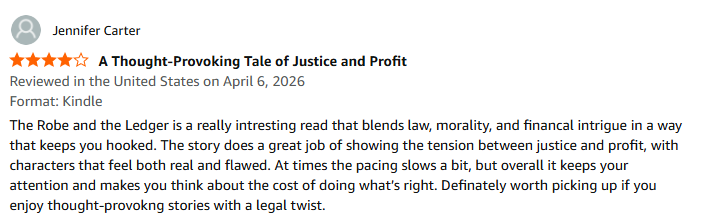
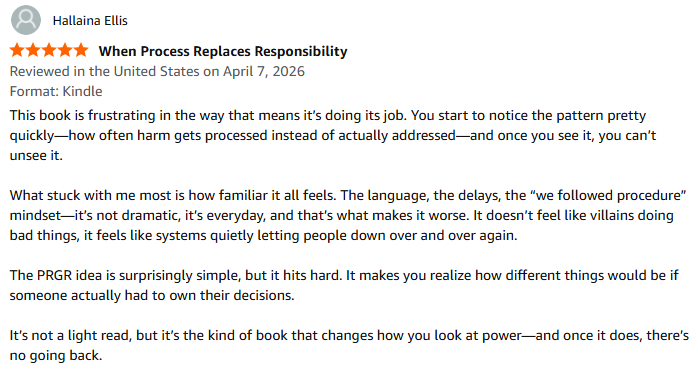
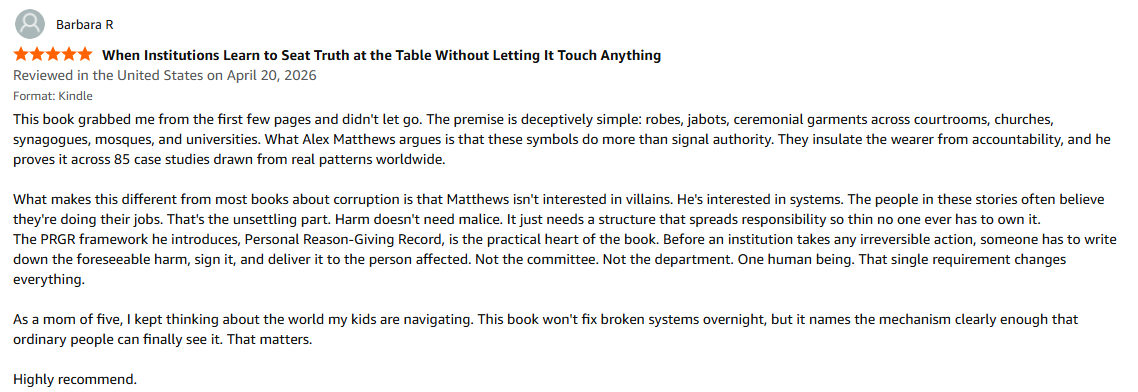
*Review Disclaimer
Reviews are provided voluntarily and independently, without influence or editorial control by the author or publisher. Certain reviewers received advance review copies (ARC) as alpha or beta readers. Professional reviewers may have been invited based on criteria such as location, expertise, or scientific background; all opinions expressed are solely those of the reviewers.